Quick Answer: Best Minecraft Wall Gradient Method
The safest Minecraft wall gradient method is to choose one material story, then place darker, rougher or mossier blocks near the base and cleaner blocks higher up. For a classic castle wall, start with mossy cobblestone and cobblestone at ground level, blend into andesite or stone through the middle, then finish with stone bricks, tuff bricks or light trim near the top.
A wall gradient should explain the build. Lower blocks collect mud, moss, impact damage and shadow. Middle blocks carry most of the surface. Upper blocks catch more light and should stay calmer so towers, windows, supports and battlements remain readable.
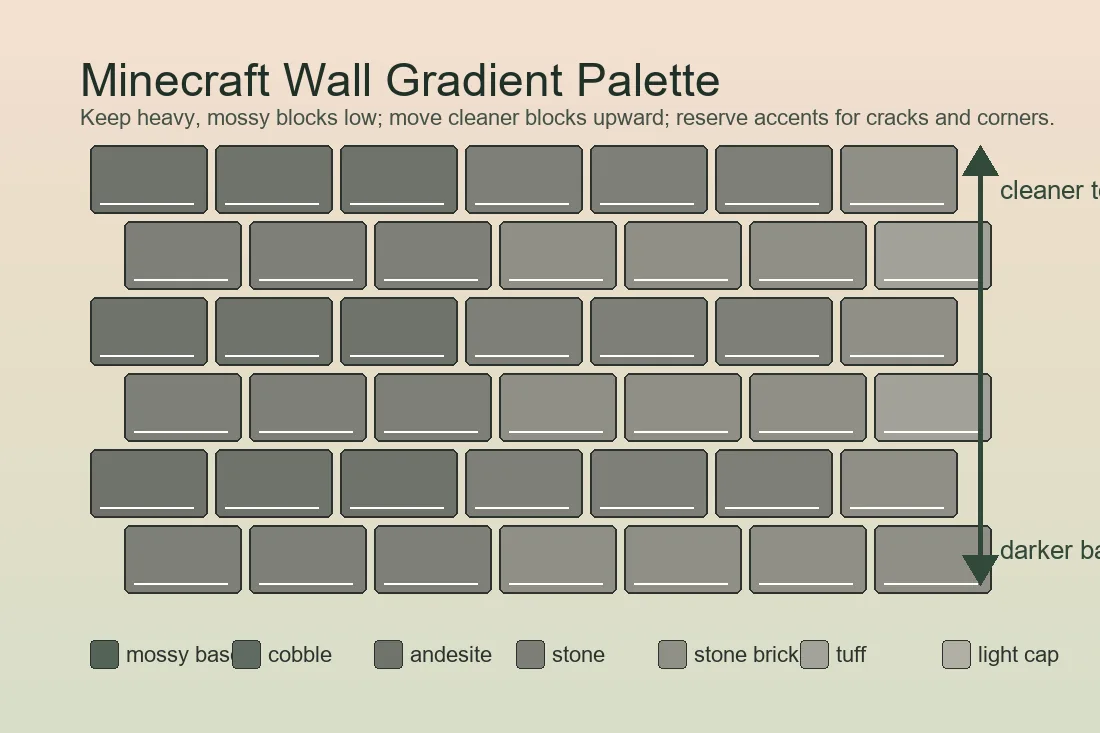
Reliable starter rules
- Use one main wall block for about half of the surface.
- Put the darkest or mossiest materials low, under ledges and beside cracks.
- Use transition blocks in clusters instead of perfect horizontal stripes.
- Match stairs, slabs and wall variants to the same material family.
- Reserve high-contrast blocks for corners, arrow slits, foundations and damage.
- Check the wall from ground level before repeating the pattern across a castle.
Why Minecraft Wall Gradients Work
Large Minecraft walls expose every repeated texture. A flat stone brick wall can look clean, but on a castle, base, cave entrance or retaining wall it often becomes a gray sheet. A controlled Minecraft wall gradient breaks that flatness by adding weight, age and direction.
The important part is not using every gray block you can find. Good wall gradients keep a believable material path: rubble and moss at the bottom, stable structural blocks in the center, and cleaner masonry or trim near the top. When the gradient follows gravity, weather and shadow, the wall looks built rather than sprinkled.
For exact vanilla wall block options and block identifiers, check the Minecraft Wiki wall reference before choosing survival materials or command names.
Scale also changes the recipe. A small starter wall may only need three blocks. A castle curtain wall, cliff base or city boundary can use five to seven blocks because the surface is large enough to show a gradual transition. The bigger the wall, the more important it is to repeat the gradient logic instead of copying the same patch everywhere.
If you need to compare block order first, open the Minecraft Gradient Generator then use this guide to decide where each block belongs on the wall.
9 Minecraft Wall Gradient Palettes
Use these wall palettes as starting recipes. Adjust the exact blocks for biome, resource pack, survival availability and the size of the wall.
| Wall Style | Gradient Sequence | Best Placement |
|---|---|---|
| Classic castle wall | mossy cobblestone -> cobblestone -> andesite -> stone -> stone bricks | Moss and cobble near the ground, clean stone bricks around parapets and windows. |
| Dark fortress wall | blackstone -> polished blackstone -> deepslate bricks -> tuff bricks -> stone bricks | Use blackstone at foundations, gates and inner shadows; lighten toward exposed upper faces. |
| Cave entrance | deepslate -> cobbled deepslate -> tuff -> andesite -> stone | Blend dark cave blocks outward into natural overworld stone around the entrance. |
| Mossy ruin | moss block -> mossy cobblestone -> cracked stone bricks -> cobblestone -> stone bricks | Cluster green and cracked blocks near damp bases, broken corners and collapsed sections. |
| Village retaining wall | mud bricks -> packed mud -> coarse dirt -> cobblestone -> stone | Keep earthier blocks low where the wall meets paths, farms or riverbanks. |
| Desert city wall | orange terracotta -> terracotta -> cut sandstone -> sandstone -> smooth sandstone | Use warm terracotta near shadowed bases and smooth sandstone on sunlit upper trim. |
| Nether wall | blackstone -> polished blackstone -> nether bricks -> red nether bricks -> crimson planks | Darken supports and lava-side shadows, then use red blocks around ribs and openings. |
| Prismarine sea wall | dark prismarine -> prismarine bricks -> prismarine -> oxidized copper -> moss | Use darker prismarine under waterlines and copper or moss where the wall feels weathered. |
| Wood and plaster wall | stripped dark oak -> spruce planks -> oak planks -> calcite -> white terracotta | Use wood for frames and lower supports, with lighter plaster panels in the center. |
How to Build a Minecraft Castle Wall Gradient
A Minecraft castle wall gradient works best when it follows structure. Start by placing the wall shape, towers, gatehouse, buttresses and battlements with the main block. Once the silhouette is readable, add the gradient in bands and clusters. The base can be rough and mossy because it touches the ground. The mid wall should stay stable. The top can be cleaner so crenellations and arrow slits are easy to read.
Avoid making one-block horizontal stripes across the full wall. Instead, create heavier patches under towers, beside drainage points, near broken stairs and around old repairs. The gradient should be strongest where the wall would naturally receive age, not evenly across every square meter.
How to Place a Wall Gradient Without Random Noise
Build the wall in layers. First place the main structural block so the shape works without decoration. Then replace about 25 to 35 percent of the surface with nearby transition blocks. Finally add the strongest accent blocks only where the wall needs weight, damage or weathering.
For most Minecraft wall gradients, use a 50/30/15/5 split. About half the wall should be the main block, 30 percent a close transition, 15 percent a secondary texture and 5 percent the strongest accent. If the accent appears everywhere, it stops feeling special and the wall becomes noisy.
Direction matters. A vertical wall can shift from dark at the bottom to light at the top. A retaining wall can be damp and green near the soil. A cliff-side wall can become darker where it enters the mountain. A fantasy wall can use color, but it still needs a rule that players can understand.
Use block shape as part of the gradient. Walls, stairs, slabs, trapdoors, fences and buttons create shadows without adding unrelated colors. If a palette feels too busy, keep the color sequence but reduce the number of shape changes.
For castles
Keep the base rough, the middle stable and the battlements clean enough to read from a distance.
For caves
Blend deepslate or blackstone into tuff, andesite and stone as the wall approaches daylight.
For villages
Use mud, cobble, moss and wood sparingly so the wall feels handmade rather than abandoned.
Survival-Friendly Minecraft Wall Gradients
In survival mode, the best wall gradient is the one you can build at scale. Cobblestone, stone, stone bricks, andesite, tuff, moss, mud bricks and deepslate are usually easier to gather than rare decorative blocks. Save blackstone, prismarine, copper, calcite or terracotta for accents unless your base is near those resources.
A practical early-game castle wall palette is cobblestone -> andesite -> stone -> stone bricks. Add mossy cobblestone near farms, water, shaded corners or old foundations. If you cannot gather enough moss, use cracked stone bricks and stairs to create age without changing the color too much.
For large survival walls, build a ten-block sample first. Check it in daylight, torchlight and rainy weather if your resource pack changes colors strongly. Then copy the placement logic, not the exact sample, across the full wall.
Common Minecraft Wall Gradient Mistakes
Using too many unrelated blocks
A wall can include contrast, but every block should support the same material story. Random bright blocks usually fight the structure.
Making perfect stripes
Horizontal bands can work on very large builds, but most walls look better with shaped clusters tied to bases, corners, windows and shadows.
Forgetting the wall shape
A gradient cannot fix a flat silhouette. Add pillars, depth, arches, buttresses or battlements before relying on texture.
Ignoring viewing distance
A detailed palette may look good up close but disappear from the road or courtyard. Test from the places players will actually stand.
FAQ
What is the best Minecraft wall gradient?
For most stone walls, mossy cobblestone, cobblestone, andesite, stone and stone bricks create a reliable light-to-dark wall gradient. Put rougher blocks near the base and cleaner blocks near the top.
How many blocks should a Minecraft wall gradient use?
Small walls usually need three to four blocks. Castle walls, city walls and large cave entrances can use five to seven blocks because the surface is large enough for a gradual transition.
What blocks are good for a Minecraft castle wall gradient?
Cobblestone, mossy cobblestone, andesite, stone, stone bricks, cracked stone bricks, tuff, deepslate bricks and blackstone are strong castle wall choices.
Should a wall gradient go from dark to light?
Usually yes. Darker, mossier or rougher blocks often work near the ground and under shadows, while lighter or cleaner blocks work near upper faces and trim.
Is a wall gradient different from a roof gradient?
Yes. Wall gradients usually follow gravity, dirt, moss, cracks and shadows. Roof gradients follow slope, eaves, weathering and the viewing angle from below.
Plan the Wall Palette Before Rebuilding the Whole Castle
Use these wall gradient recipes as a starting point, then compare candidate blocks in the generator before committing to hundreds of placed blocks.
Use the Minecraft Gradient Generator