Quick Answer: A Reliable Minecraft Castle Design Method
A strong Minecraft castle design begins with a footprint, not a finished tower. Mark the outer wall, place the gatehouse, reserve a courtyard, and position the keep before committing to height. This lets you test movement, sight lines and scale while every change is still cheap.
For a manageable first castle, use a 35- to 45-block outer footprint, walls 7 to 10 blocks high, corner towers 3 to 6 blocks taller than the walls, and a keep that is visibly taller than everything else. The measurements can change, but the hierarchy should remain obvious from a distance.
Limit the main palette to two or three stone families plus one wood and one accent. A controlled stone-to-deepslate gradient adds age and weight; random blocks scattered at equal frequency usually create noise instead of texture.
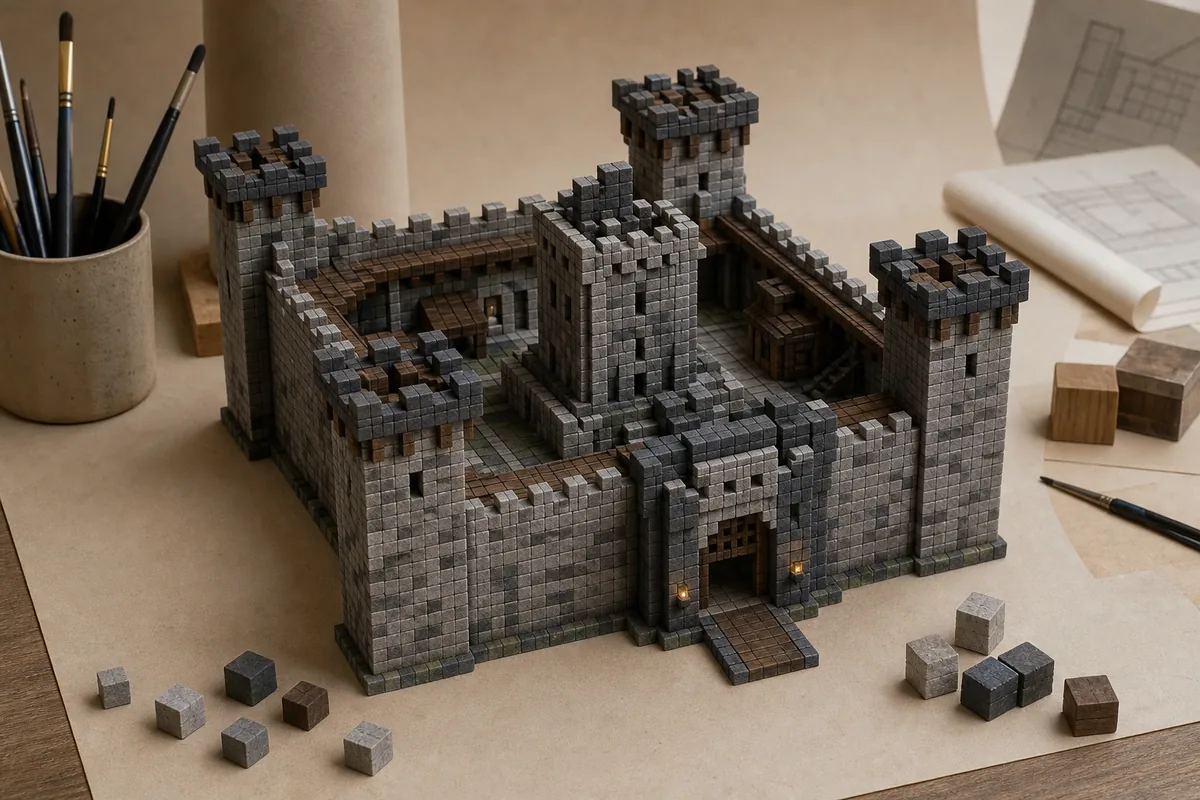
Fast castle planning recipe
- Choose a hill, plain, coast or cliff that supports the silhouette.
- Mark the outer wall and gate before building upward.
- Place corner towers, the keep and a usable courtyard.
- Test one wall module with depth, windows and battlements.
- Lock a main palette and one vertical weathering gradient.
- Repeat modules, then add roofs, paths, lighting and interiors.
Why Good Minecraft Castle Designs Read Clearly
Players recognize a castle through hierarchy: a dominant keep, defensive walls, towers at important corners, a controlled entrance and an enclosed space. If every tower is the same height and every wall receives the same detail, the build becomes a box with ornaments rather than a fortress.
Silhouette comes before surface detail. Towers should break the roofline, the gatehouse should frame the entrance, and the keep should remain visible from outside the walls. Test the build from ground level as well as from above, because most screenshots and player movement happen near eye level.
Check exact vanilla block names and variants in the Minecraft Wiki block reference before turning a creative palette into a survival material list.
Depth makes plain walls believable. Recess windows by one block, push buttresses outward, place stairs or slabs beneath ledges, and let towers project beyond the curtain wall. Shadows from these small offsets often matter more than adding another decorative block.
Material changes should explain structure or weather. Darker blocks belong naturally near foundations, wet moat edges, undersides and deep recesses. Cleaner stone fits protected upper courses, repaired sections and formal interiors. Moss works best in damp clusters instead of an even confetti pattern.
Test the light-to-dark material order with the Minecraft Gradient Generator before applying the sequence across an entire castle wall.
Minecraft Castle Block Palettes and Gradients
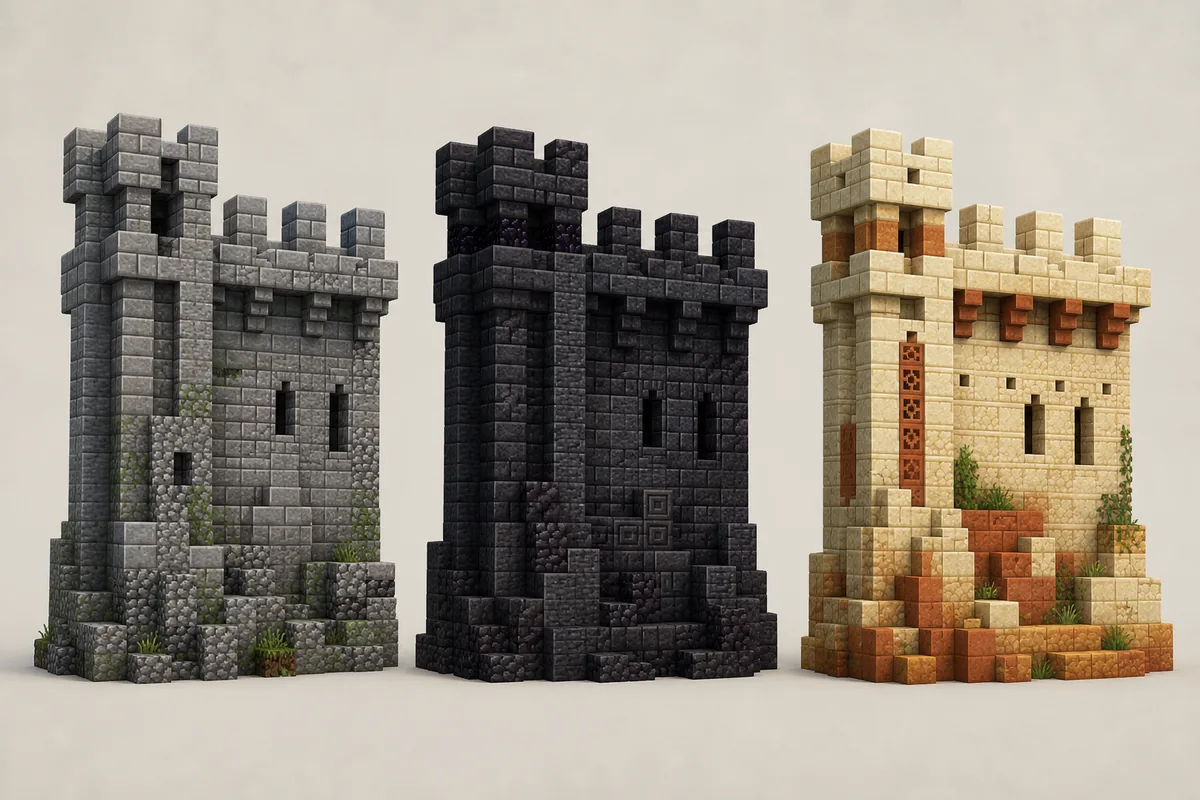
Choose a palette for the castle mood, biome and material budget. Each sequence below is a starting point; cluster transitions by foundation, damp area, repair or shadow instead of laying perfect horizontal stripes.
| Castle Style | Block Palette | Best Placement |
|---|---|---|
| Classic medieval | stone bricks -> andesite -> cobblestone -> cracked stone bricks | Use stone bricks for the main wall, rougher blocks near the base and cracked blocks in small aged clusters. |
| Dark fortress | stone -> tuff -> deepslate bricks -> blackstone | Darken foundations, gate recesses and lower towers while keeping edges readable. |
| Overgrown ruin | mossy cobblestone -> cobblestone -> andesite -> stone bricks | Concentrate moss near water, soil, broken corners and shaded courtyards. |
| Warm desert castle | smooth sandstone -> cut sandstone -> sandstone -> terracotta | Use terracotta beneath roofs, around gates and in sun-baked repaired sections. |
| Mountain keep | cobbled deepslate -> tuff -> andesite -> stone | Blend the lower walls into a cliff and brighten blocks toward the occupied upper levels. |
| Fantasy palace | calcite -> diorite -> stone bricks -> amethyst accents | Keep bright or magical blocks around spires, windows and focal towers rather than every wall. |
Plan the Castle Layout, Towers and Courtyard
Begin with colored temporary blocks on the ground. Mark the gate, wall line, four tower centers, keep footprint, courtyard paths and any stable, forge or storage wing. Walk the route from gate to keep. If movement already feels cramped, decoration will make it worse.
A square layout is easiest to repeat, but a slight offset can make the castle feel adapted to terrain. Let one tower follow a hill, widen the wall beside a cliff, or angle the gate toward an existing road. Intentional asymmetry is more convincing than moving pieces randomly.
Give every large space a job. The courtyard can connect a forge, stable, storage hall and keep; wall walks should reach towers; the gate should lead somewhere useful. A beautiful shell with no routes or rooms quickly feels unfinished in survival play.
Build the Castle in a Stable Order
First build the footprint and one complete wall-and-tower module. The module proves wall thickness, tower diameter, window rhythm, battlement scale and palette. Fixing one module is much faster than rebuilding four finished towers.
Next raise the outer walls and gatehouse, then build the keep as the visual anchor. Stand outside the castle regularly. If the keep disappears behind the walls, add height or shift its position before completing the roof.
Add gradients after the main masses work. Place dark foundation clusters, rough transitions and moss in response to terrain and water. Avoid a perfectly even band around every wall; real-looking weathering changes around drains, corners, buttresses, paths and repairs.
Finish with roofs, wall walks, stairs, lighting, flags, landscaping and interiors. Detail should support navigation and scale: lamps mark routes, banners frame important entrances, and repeated windows reveal floor heights.
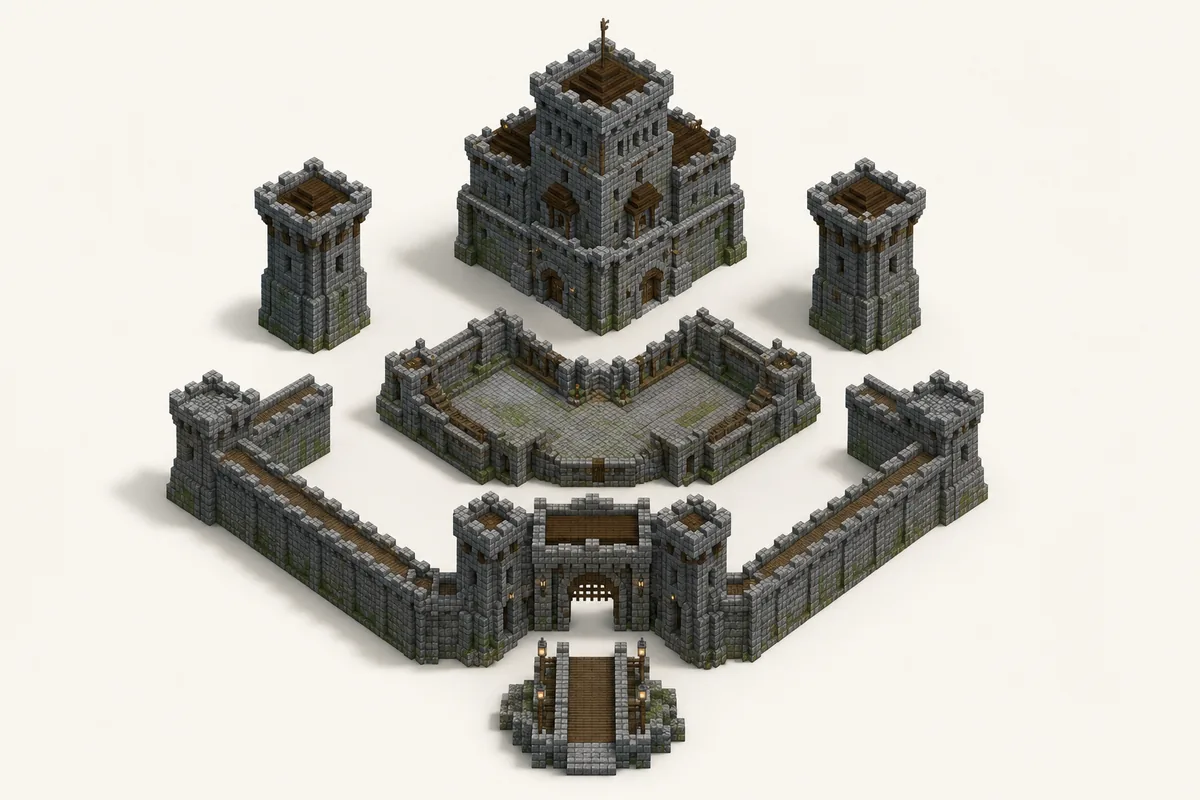
Primary mass
The keep, outer wall and corner towers establish hierarchy and silhouette before decoration.
Repeated module
A tested wall bay controls window spacing, buttresses, battlements and material rhythm.
Connection
Gate, paths, bridge, stairs and wall walks turn separate structures into a usable castle.
Make the Minecraft Castle Build Survival-Friendly
Estimate material by modules rather than guessing the whole castle. Count one wall bay and one tower floor, then multiply by the number of repeats. Add a buffer for stairs, slabs and mistakes. This reveals whether the first design is realistic before you mine thousands of blocks.
Use farmable or abundant blocks for the main mass: stone, cobblestone, stone bricks, tuff, andesite, spruce and dark oak are easier to scale than quartz, calcite, amethyst or copper. Reserve expensive blocks for gates, roof edges, windows and focal rooms.
Build a functional core early. Secure storage, beds, furnaces, crafting and safe lighting inside the keep or gatehouse before finishing distant walls. The castle can remain useful throughout construction instead of becoming a long empty project.
Common Minecraft Castle Design Mistakes
Building every tower first
Finished towers lock the footprint too early. Mark the whole layout and test one module before repeating it.
Using one flat wall material
A single texture across a large surface removes scale. Add controlled depth, structural trim and a restrained weathering gradient.
Adding random block noise
Equal scattering makes materials look accidental. Cluster cracked, mossy and dark blocks where age, water or shadow explains them.
Making walls too thin
One-block walls limit windows, walkways and shadows. Use enough thickness for recesses and a readable wall top.
Forgetting the interior route
Plan how players move from gate to courtyard, keep, towers and wall walks before filling every space.
Minecraft Castle Design FAQ
What is a good Minecraft castle size for beginners?
A 35- to 45-block outer footprint is large enough for four towers, walls, a courtyard and a modest keep without becoming an endless survival project. Test the route before raising the walls.
What blocks are best for a Minecraft castle?
Stone bricks, stone, cobblestone, andesite, tuff, deepslate, spruce and dark oak form reliable castle palettes. Use cracked, mossy or expensive blocks as controlled accents.
How tall should castle towers be in Minecraft?
Corner towers usually read well when they rise three to six blocks above the curtain wall. The keep should be taller again so the hierarchy remains visible outside the castle.
How do I make Minecraft castle walls less flat?
Recess windows, project buttresses and towers, add ledges with stairs or slabs, and use a restrained foundation gradient. Depth and shadow work better than random decoration.
Should a Minecraft castle be symmetrical?
Symmetry helps at the gate and in formal layouts, but small terrain-driven offsets often feel more believable. Keep repeated modules consistent while allowing the overall footprint to follow the site.
Test Your Castle Palette Before Building
Compare nearby stone, tuff, andesite, deepslate, blackstone, wood or sandstone blocks before repeating a palette across the walls.
Use the Minecraft Gradient Generator