Quick Answer: How to Plan Minecraft Tower Designs
The most reliable Minecraft tower designs start with a small footprint, a visible height hierarchy and a roof or crown that can be recognized from a distance. For a first tower, mark an 11-by-11 or 13-by-13 footprint, build a 5-block-high test floor, then check the shape from ground level before repeating it upward.
A tower should not be one straight tube. Create three readable stages: a grounded base, a narrower or quieter middle, and a top that widens, tapers or changes material. Even a simple watchtower looks intentional when the base feels heavy, windows follow a rhythm, and the roof projects one or two blocks beyond the wall.
Keep the palette controlled. Use one main stone or wood family, one transition family and one small accent. Darker blocks usually work near foundations, under balconies and below roof eaves; lighter or cleaner blocks can mark occupied upper floors and edges.
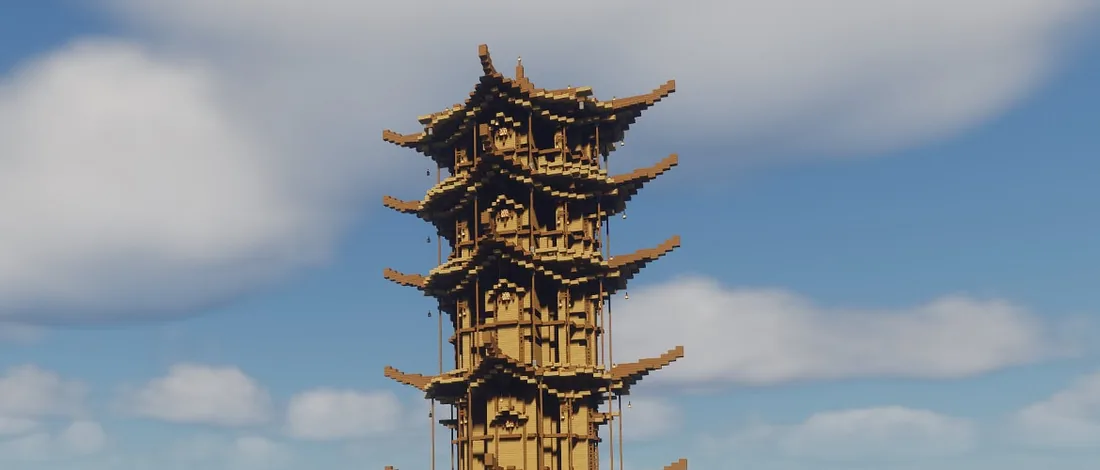
Fast tower planning recipe
- Choose the tower job: watchtower, wizard tower, keep, lighthouse, ruin, fantasy spire or modern tower.
- Mark an odd-number footprint so doors, windows and roof peaks can stay centered.
- Test one floor with walls, stairs, windows and usable headroom.
- Change the silhouette every 5 to 8 blocks with a ledge, taper, balcony or material band.
- Make the top visibly different from the shaft.
- Apply gradients in clusters that follow shadow, weather and structure.
Why Good Minecraft Tower Designs Read Clearly
A tall build is seen as a silhouette before it is seen as a wall texture. The player notices the base width, the rhythm of the shaft and the shape of the roof first. If those three parts are clear, modest details look deliberate. If the outline is weak, adding fences, trapdoors and random blocks only makes the tower busier.
Repetition needs interruption. Windows can repeat every floor, but one balcony, wider observation room or roof transition should break the vertical line. This creates a focal point and also gives the interior a useful destination.
For real tower examples and silhouette inspiration, compare the official Minecraft Survival Tower feature with your footprint before committing to the full height.
Depth matters more on a tower because the same wall repeats vertically. Recess windows, project corner posts, use stairs or slabs beneath ledges and move the upper room outward by one block. These offsets cast shadows that remain visible even when the tower is viewed from far away.
The interior must be planned with the exterior. A beautiful 9-block-wide shaft can fail if a spiral staircase consumes the whole room. Reserve the stair path, landings, door direction and floor openings before decorating the facade.
Use the Minecraft Gradient Generator to test a stone, wood, copper or deepslate sequence before repeating it across every floor.
7 Minecraft Tower Design Ideas and Matching Palettes
Choose a tower type by function and biome, then adapt the material sequence to the resources you can repeat. The palette should reinforce the silhouette rather than cover it with equal random variation.

| Tower Type | Block Palette | Design Priority |
|---|---|---|
| Medieval watchtower | stone bricks -> andesite -> cobblestone -> spruce logs | Use a solid stone base, narrow arrow windows and a timber observation floor that projects one block. |
| Wizard tower | deepslate bricks -> tuff -> purple concrete -> amethyst accents | Taper the shaft, offset one upper room and reserve bright magical blocks for the crown. |
| Castle keep tower | stone -> stone bricks -> cracked stone bricks -> dark oak | Prioritize wide floors, battlements and interior routes rather than an extremely thin spire. |
| Coastal lighthouse | calcite -> white concrete -> red terracotta -> copper | Use a bold horizontal signal band and a readable lantern room at the top. |
| Overgrown ruin | mossy cobblestone -> cobblestone -> andesite -> moss | Break the roofline, remove selected corners and cluster moss where water and soil would collect. |
| Fantasy spire | calcite -> diorite -> prismarine -> oxidized copper | Keep the lower mass calm, then increase color and shape contrast toward the crown. |
| Modern tower | smooth stone -> white concrete -> tinted glass -> dark prismarine | Repeat clean floor bands and use glass as a controlled vertical strip instead of covering every wall. |
Tower Footprints, Height and Tapering Ratios
Odd-number footprints are easier to center. A 9-by-9 tower is compact but leaves little room after stairs and walls. An 11-by-11 footprint suits a small watchtower, while 13-by-13 or 15-by-15 gives enough space for landings, storage and a decorative upper room. Circular towers need a tested block circle before you build upward.
Use height in modules. A practical floor is 4 blocks of interior height plus one floor layer, so the facade changes every 5 blocks. Three modules create a roughly 15-block shaft before the roof; four or five modules produce a landmark tower. Add visible ledges at module boundaries so the height looks measured rather than stretched.
Taper by moving selected walls inward one block after two or three floors, or keep the shaft straight and widen only the top room. Do not narrow every floor: the result becomes a pyramid. The change should be large enough to read from a distance but still leave a usable stair path.
Build a Minecraft Tower in a Stable Order
Start with the footprint, entrance and stair route. Build temporary floor rings at the planned heights, then stand at several distances to inspect the proportions. Moving a wool outline is cheap; rebuilding a finished stone shaft is not.
Complete one facade bay before repeating it. Test the window width, corner supports, ledge depth and block gradient on a single floor. If the bay reads well in daylight and at night, repeat the rhythm with one deliberate variation near the top.
Build the roof or crown as a separate shape test. A steep roof needs enough overhang to balance the tower width, while battlements need corner mass and a visible parapet. Place the outline in temporary blocks, check it from below, then replace it with the final palette.
Add the gradient after the main shape works. Put darker and rougher blocks near the base, undersides, wet corners and deep window recesses. Keep cleaner blocks on protected faces and upper trim. Cluster transitions instead of drawing perfect stripes around the tower.
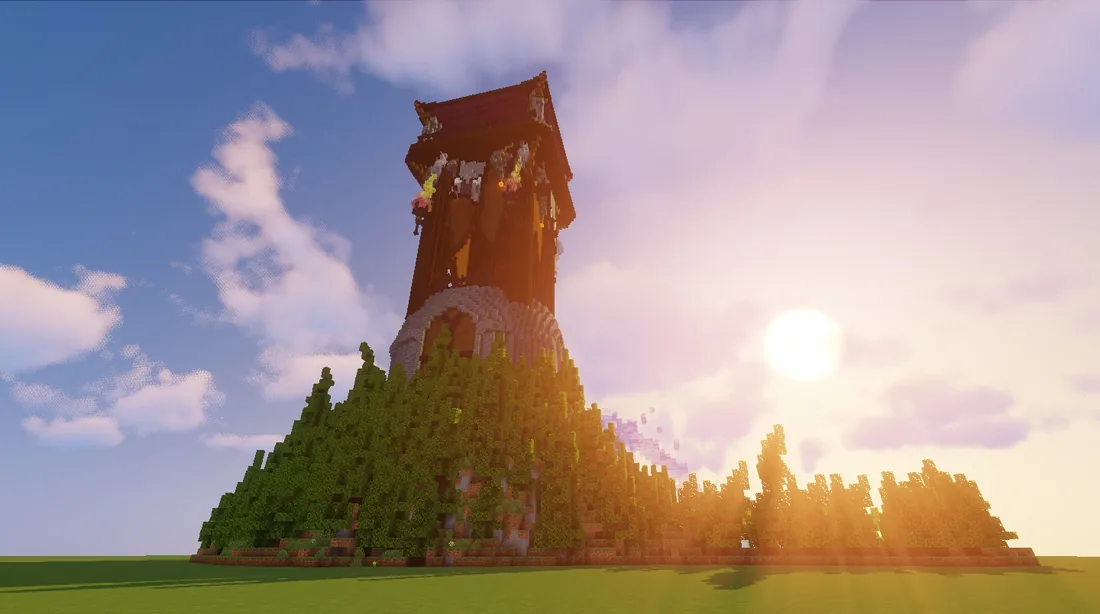
Base
Use weight, an obvious entrance and enough wall thickness for stairs or storage.
Shaft
Repeat a floor rhythm, then interrupt it with one ledge, balcony or taper.
Crown
Make the roof, battlements, lantern room or magical top recognizable from far away.
Make the Tower Practical in Survival Mode
Build with abundant blocks first. Stone, cobblestone, stone bricks, tuff, spruce and oak can carry most of the mass. Reserve copper, amethyst, quartz, sea lanterns, prismarine or tinted glass for the crown and focal details where a small amount has more visual impact.
Estimate one floor before gathering everything. Count the wall blocks, stairs, slabs, logs and glass for one module, then multiply by the number of floors and add a buffer for the roof. This prevents a half-finished tower from becoming an oversized resource sink.
Give each floor a job: entrance and storage below, crafting or enchanting in the middle, bedroom or map room above, and observation or beacon space at the top. Light stairs and landings early so the structure remains safe while construction continues.
Common Minecraft Tower Design Mistakes
Building a straight tube
A constant footprint and flat wall repeat without a focal point. Add a ledge, taper, balcony, wider room or distinct crown.
Making the tower too thin
Exterior proportions can hide an unusable interior. Test stairs, landings and headroom inside the first floor before building higher.
Using random block noise
Scattered blocks at equal frequency blur the structure. Put variation where shadow, age, weather or construction logic explains it.
Choosing the roof last
The crown controls the silhouette. Test its height and overhang while the tower is still an outline.
Repeating every floor exactly
Consistent rhythm is useful, but one deliberate interruption near the top gives the tower identity and scale.
Minecraft Tower Designs FAQ
What is a good size for a Minecraft tower?
An 11-by-11 footprint works for a small watchtower, while 13-by-13 or 15-by-15 gives more room for stairs, landings and useful floors. Test the interior before choosing the final height.
How tall should a Minecraft tower be?
Use 5-block floor modules. Three modules plus a roof creates a compact tower; four or five modules creates a landmark. The tower should be tall enough to read clearly without making the shaft look stretched.
How do I make a Minecraft watchtower design look better?
Use a heavy base, narrow repeated windows, a projecting observation floor and a roof or battlement wider than the shaft. Keep the palette simple and place darker blocks beneath ledges.
How do I build a spiral staircase inside a tower?
Reserve a central column or outer-wall path before decorating. Test the rise, headroom and landing direction on the first floor, then repeat the same module upward.
What blocks work well for a wizard tower?
Deepslate, tuff, dark oak and stone create a calm base. Add purple concrete, warped wood, amethyst, copper or prismarine near the upper room and crown as limited magical accents.
Test Your Tower Palette Before Building Higher
Compare nearby blocks for the base, shaft and crown before repeating a material sequence across every floor.
Use the Minecraft Gradient Generator