Quick Answer: What Blocks Look Good with Tuff in Minecraft?
The best blocks to pair with tuff are stone, stone bricks, andesite, cobblestone, deepslate, calcite, light gray terracotta, stripped spruce, weathered copper and exposed copper. Stone and andesite create a natural gray gradient. Deepslate gives the palette a darker foundation. Calcite adds a clean highlight, while copper introduces controlled color without fighting tuff's mottled texture.
For most walls, start with 55 percent tuff or tuff bricks, 25 percent stone-family blocks, 15 percent dark or light transition blocks and 5 percent accents. Keep raw tuff in irregular patches, polished tuff around frames and edges, and tuff bricks in areas that should feel intentionally built.
If you only need one dependable sequence, use deepslate bricks → cobbled deepslate → tuff bricks → polished tuff → tuff → andesite → stone → calcite. Shorten the sequence for small builds and reserve calcite for the brightest edges.
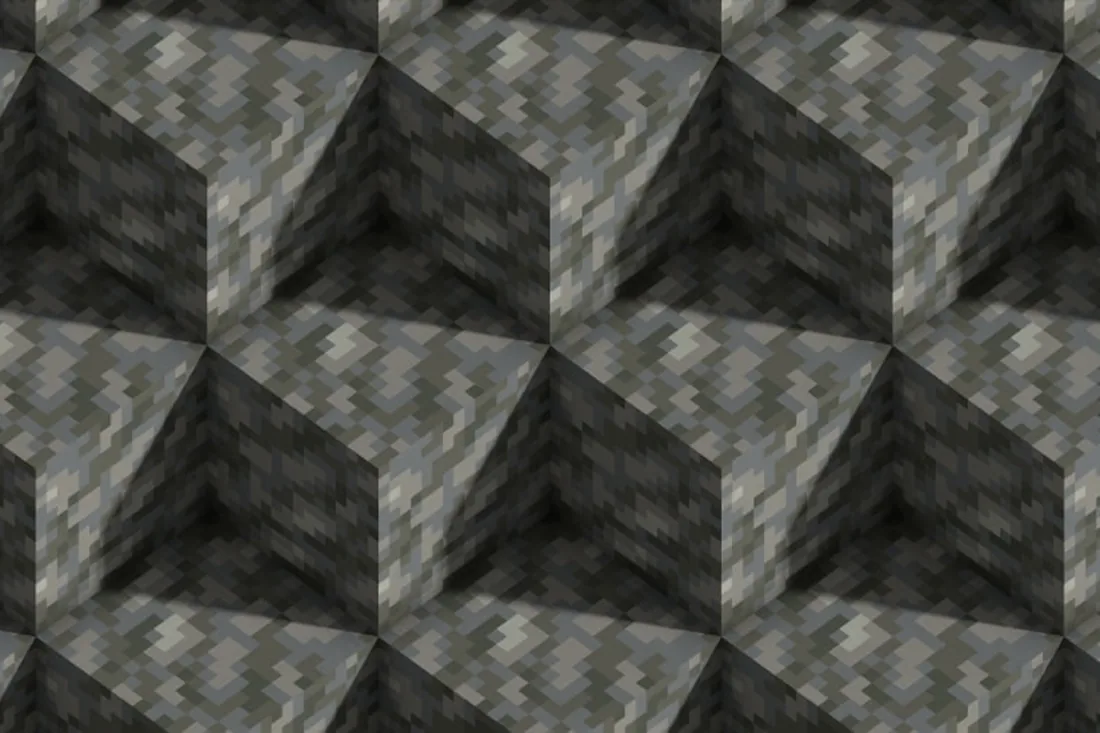
Fast tuff palette recipe
- Choose whether the build should feel natural, industrial, ancient or clean.
- Use tuff as the middle texture rather than the darkest or brightest block.
- Add only one dark family and one light family around it.
- Place polished tuff or tuff bricks where the structure needs readable edges.
- Repeat accent blocks in small clusters instead of isolated single blocks.
- Check the palette from normal player distance before adding more variation.
Why a Minecraft Tuff Gradient Works
Tuff sits between smooth stone and rough deepslate in both value and texture. That makes it a useful transition block, but it also means random mixing can become muddy. A strong Minecraft tuff gradient gives each block a job: dark blocks establish depth, tuff carries the main surface, smoother gray blocks calm the texture and a small highlight marks exposed edges.
The expanded tuff family makes this easier. Raw tuff reads as geology, polished tuff reads as cut stone, tuff bricks read as architecture and chiseled tuff works as a rare focal detail. Using those variants by function creates a clearer build than scattering every version evenly.
Mojang's official Tricky Trials update overview shows how the tuff and copper families support the Trial Chamber's layered material language.
Color temperature matters too. Spruce and dark oak warm the gray palette, copper creates a stronger orange-teal contrast, and calcite pushes the build toward a colder ancient-temple look. Choose one direction instead of combining every accent family in the same wall.
Scale controls complexity. A five-block cottage wall may need only tuff, stone bricks and spruce. A large chamber can support six or seven steps because viewers have enough distance to read the transition.
For a broader method that works with every block family, use the Minecraft color palette guide before turning the chosen colors into a tuff-specific gradient.
8 Minecraft Tuff Block Palettes
These palettes are ordered from darker or heavier blocks toward lighter or cleaner blocks. You do not need every block in each row; use four to six steps for most builds and expand only when the surface is large enough.

| Build style | Suggested block sequence | Best placement |
|---|---|---|
| Natural cave | Cobbled deepslate → tuff → andesite → stone → calcite | Dark cave base, rough walls and bright mineral seams |
| Trial Chamber | Tuff bricks → polished tuff → cut copper → exposed copper → oxidized copper | Structural bays, trim bands and mechanical rooms |
| Ancient ruin | Mossy stone bricks → stone bricks → tuff bricks → tuff → gravel | Broken walls, buried foundations and weathered towers |
| Mountain base | Deepslate bricks → cobbled deepslate → tuff → stone → smooth stone | Lower supports, entrance tunnels and retaining walls |
| Warm workshop | Tuff bricks → polished tuff → stripped spruce → spruce planks → copper | Floors, furnace rooms, beams and storage walls |
| Clean fortress | Deepslate tiles → tuff bricks → polished tuff → stone bricks → calcite | Gatehouses, towers, arches and formal corridors |
| Overgrown temple | Deepslate → tuff bricks → tuff → mossy cobblestone → moss block | Lower walls, damp corners and garden transitions |
| Desert excavation | Tuff → andesite → packed mud → mud bricks → terracotta | Dig sites, buried rooms and warm terrain edges |
How to Use Tuff, Polished Tuff and Tuff Bricks
Use raw tuff where the surface should feel excavated, eroded or naturally formed. Its uneven pixels blend well with andesite, stone, gravel and deepslate, especially in caves and mountain walls. Keep clusters irregular and avoid checkerboard placement.
Use polished tuff as a transition and edge block. It can separate a rough wall from a clean floor, frame an arch or create a quieter band between raw tuff and tuff bricks. Use tuff bricks for load-bearing visual areas such as pillars, foundations and corridor walls. Chiseled tuff and chiseled tuff bricks are strongest as occasional markers, not as the main field texture.
How to Place a Tuff Gradient Without Noise
Build gradients in zones rather than random percentages. Put the darkest blocks under overhangs, near the ground and inside recesses. Place tuff across the middle field, then move toward stone, andesite or calcite on exposed edges and upper surfaces. The direction should match the story of light, moisture or construction.
For a wall, use patches that are at least two or three blocks wide before changing material. For a floor, create lanes or borders instead of scattered pixels. For pillars, keep the strongest contrast at the base and capital so the center remains readable.
When copper is included, treat it as a separate accent rhythm. Repeat it around lamps, doors, vault-like details or horizontal bands. Do not let orange and green copper states replace the gray gradient; they should sit on top of it.

Wall rule
Use large dark-to-light patches and reserve single blocks for weathering near existing patch edges.
Floor rule
Keep a calm walking field, then move texture into borders, damaged corners or directional bands.
Pillar rule
Use tuff bricks for the shaft, darker blocks at the base and polished or chiseled blocks at transitions.
Cave rule
Let tuff bridge stone and deepslate, with calcite or moss appearing only where the cave feature explains it.
Survival-Friendly Tuff Palette Planning
A survival palette should match the resources you can gather repeatedly. Tuff, stone, cobblestone and andesite are the safest core because they scale to large walls. Save calcite, copper oxidation stages and decorative chiseled blocks for focal areas until the main structure is complete.
Test the palette with a small eight-by-eight sample wall near the build. View it in daylight, rain and torchlight. If tuff disappears into stone, add a darker border or polished transition. If the wall looks too busy, remove one texture before collecting more materials.
For staged construction, begin with tuff and stone bricks, add deepslate supports, then replace selected blocks with polished tuff, moss or copper during the detailing pass. This keeps the build usable while the final gradient develops.
Common Tuff Palette Mistakes
Using every gray block
Stone, cobblestone, andesite, gravel, tuff and deepslate are all compatible, but using all of them equally creates static. Pick one main texture, two transitions and one accent.
Treating polished blocks as random weathering
Polished tuff and tuff bricks communicate construction. Place them around edges, pillars, floors and openings instead of mixing them randomly into natural rock.
Adding copper without a rhythm
One isolated copper block looks accidental. Repeat copper in bands, fixtures, doors or mechanical details and limit the number of oxidation states in small rooms.
Making the brightest block too common
Calcite and very light stone should guide attention. Large amounts can overpower tuff and make the palette feel white rather than mineral gray.
Ignoring build distance
Tiny texture changes disappear from far away. Large walls need broad value zones first; close-up detail should be added only after the silhouette and main gradient work.
Minecraft Tuff Gradient FAQ
What blocks look good with tuff in Minecraft?
Stone, stone bricks, andesite, deepslate, calcite, spruce, mud bricks and copper all work well with tuff. Choose combinations by role: deepslate for shadows, stone for transitions, calcite for highlights, wood for warmth and copper for accents.
What blocks look like tuff in Minecraft?
Andesite, stone, gravel and cobbled deepslate share parts of tuff's gray mineral texture. Andesite is the closest smooth transition, while cobbled deepslate is a darker and rougher companion. They should support tuff rather than replace it evenly.
What is the best Minecraft tuff gradient?
A flexible sequence is deepslate bricks, cobbled deepslate, tuff bricks, polished tuff, raw tuff, andesite, stone and calcite. Use four to six of those blocks for small builds and the full sequence only on large surfaces.
Do tuff and copper look good together?
Yes. Gray tuff makes orange, exposed and oxidized copper easier to read. Keep tuff as the dominant material and repeat copper in trim, lamps, doors or mechanical bands so the contrast feels intentional.
Should I use tuff bricks or raw tuff for walls?
Use tuff bricks for constructed walls, pillars and foundations. Use raw tuff for cave faces, ruined patches and weathered transitions. Combining both works best when polished tuff separates the rough and formal areas.
How much variation should a tuff wall have?
Most medium walls need one main tuff texture, two transition blocks and one accent family. Start near a 55/25/15/5 ratio, then simplify if the wall looks noisy from normal player distance.
Turn Your Tuff Palette into a Build Plan
Use the Minecraft Gradient Generator to compare block order, then test the chosen sequence on a sample wall before committing resources.
Open the Gradient Generator