Quick Answer: Best Minecraft Stairs Design Method
The strongest Minecraft stairs design starts with movement. Decide where the player enters, where the staircase turns, where a landing belongs and which side needs a railing before choosing decorative blocks. A one-block-wide utility stair can stay plain, but a base entrance, tower stair or garden terrace needs a clear walking line, support blocks and a palette that matches nearby walls, floors and paths.
Use stairs as a transition, not just a vertical shortcut. The bottom should connect to a path, floor or terrain gradient. The middle should show rhythm through steps, rail posts, lamps or walls. The top should arrive at a door, balcony, tower room or platform without feeling like the build simply stopped.
A useful rule is 60 percent main step material, 25 percent support or border, 10 percent railing and lighting, and 5 percent weathering. Wider staircases can use more contrast, but every block should still have a role.
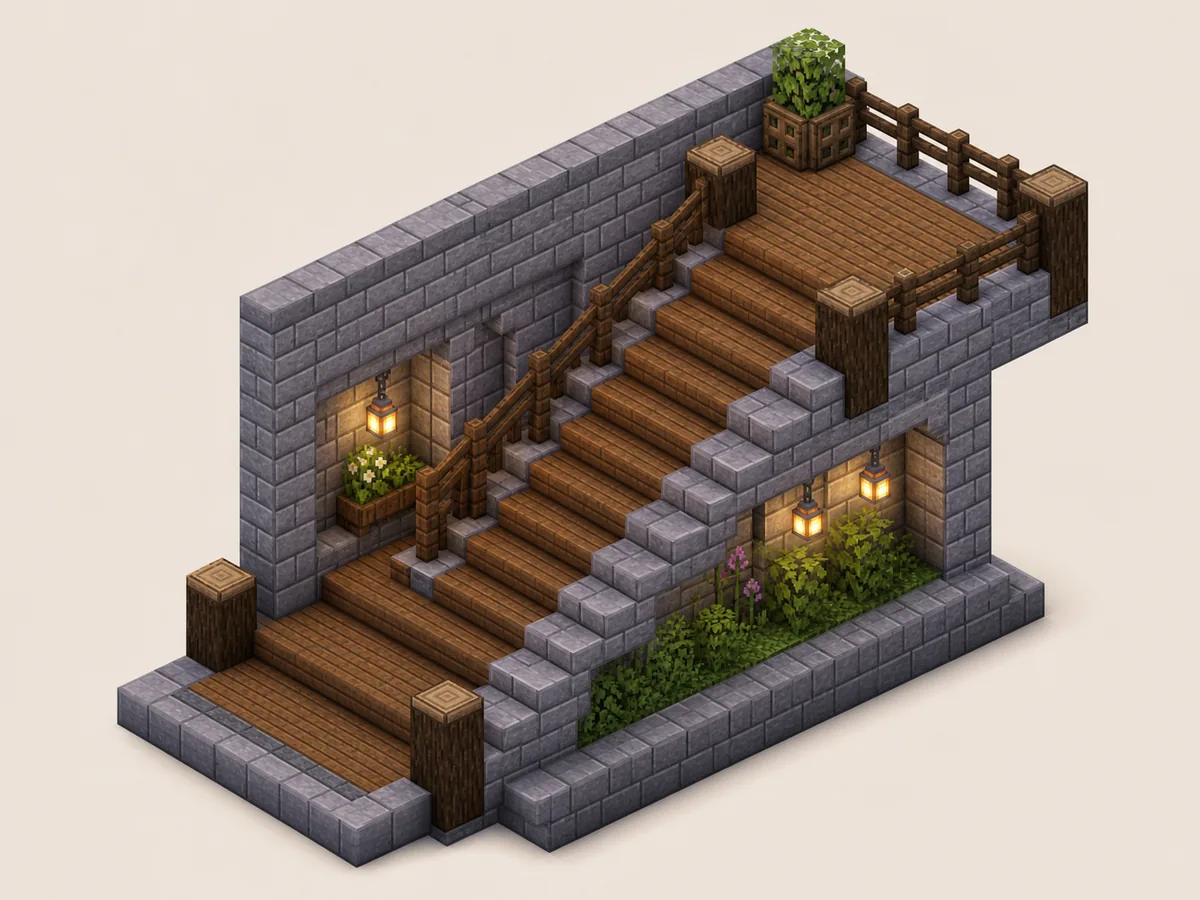
Fast staircase recipe
- Choose straight, switchback, spiral or terraced stairs based on the space.
- Pick one main stair block before adding border blocks.
- Use landings when the staircase turns, climbs more than one floor or enters a room.
- Add rails, walls, fences or trapdoors only where they clarify the edge.
- Blend the bottom and top into floors, paths, walls or terrain.
- Test the staircase from normal player eye level before repeating it.
Why Minecraft Stairs Designs Work
Stairs are visible from multiple angles, so weak block choices show quickly. The top surface reads like a floor, the side reads like a wall, and the edge often becomes a railing or trim. That is why a staircase usually needs stronger planning than a flat path.
Good Minecraft staircase ideas separate structure from decoration. Wood stairs feel warm and practical, stone stairs feel heavy and formal, mossy blocks suggest age, and deepslate or blackstone can make underground stairs feel deeper. The palette should explain the build setting before accents are added.
For vanilla stair behavior, names and block variants, check the Minecraft Wiki stairs reference when you need version-specific material details.
The main search intent is design guidance rather than basic crafting. Players usually know how stairs work, but they need help choosing dimensions, landings, palettes and side details that do not become noisy.
This page stays separate from floor patterns, bridge design and wall gradients because stairs must solve vertical movement, edge safety, turn direction and arrival points at the same time.
If the stair palette feels close but the colors fight each other, start with the Minecraft color palette guide then turn the chosen materials into a staircase sequence.
12 Minecraft Stairs Design Ideas and Palettes
Use these Minecraft staircase ideas as starting points. Swap blocks for biome, room size, survival access and whether the stairs are interior, exterior, hidden or decorative.
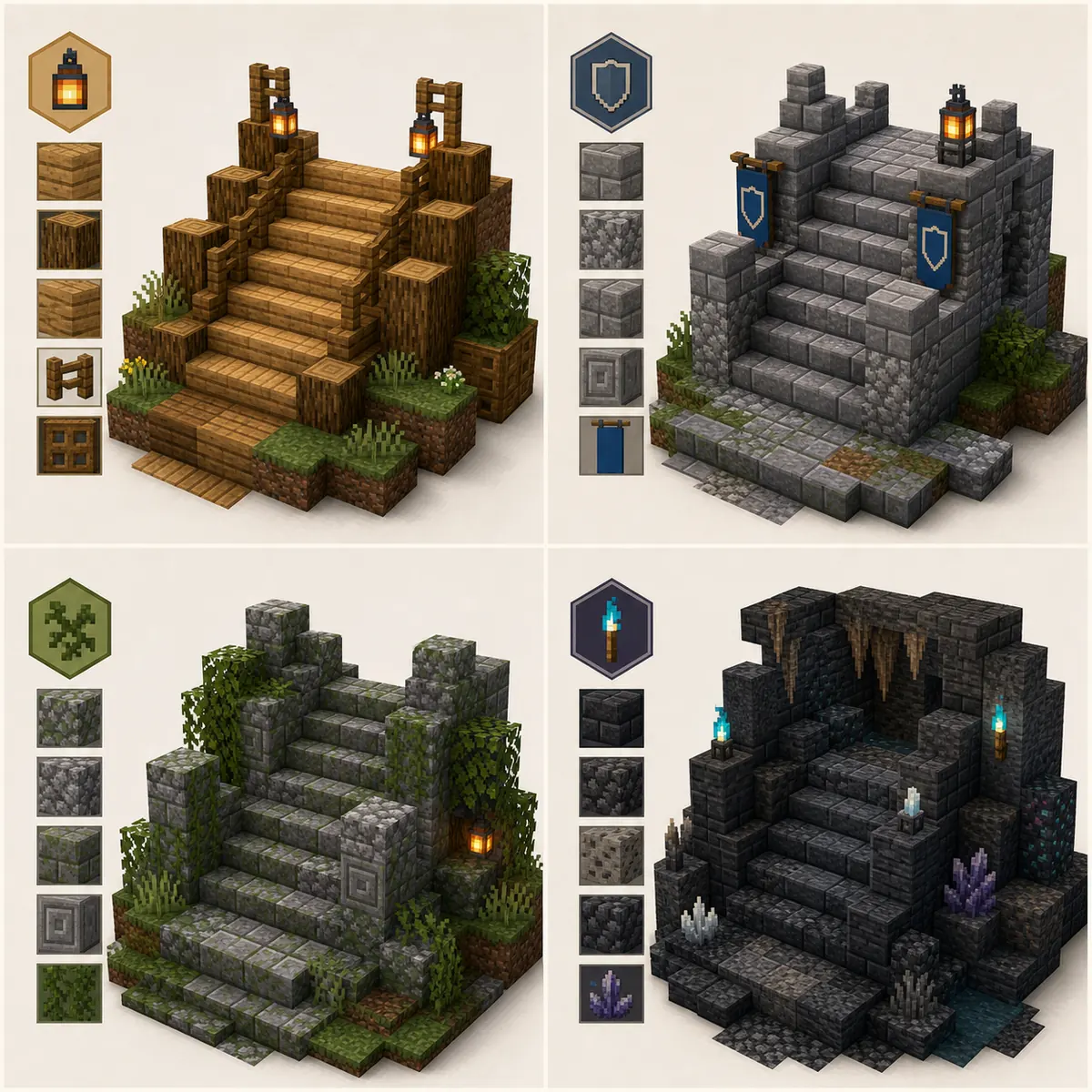
| Stair Style | Block Palette | Best Placement |
|---|---|---|
| Starter wooden stairs | oak stairs -> spruce slabs -> stripped oak -> fence rails | Best for small houses, farms and village paths where warmth matters more than heavy structure. |
| Stone castle staircase | stone brick stairs -> andesite -> cracked stone bricks -> deepslate trim | Use for towers, keeps and walls; darken edges and landings so the stairs feel supported. |
| Mossy ruin stairs | mossy cobblestone -> cobblestone stairs -> stone bricks -> vines | Cluster moss near corners, broken edges and damp ground instead of scattering it evenly. |
| Deepslate cave stairs | stone stairs -> tuff -> cobbled deepslate -> deepslate tiles | Blend from brighter entrance blocks into darker cave depth and keep the walking line readable. |
| Nether fortress stairs | blackstone stairs -> basalt -> nether bricks -> crimson trapdoors | Let dark blocks carry the structure and reserve crimson or shroomlight for rail rhythm. |
| Desert temple stairs | sandstone stairs -> cut sandstone -> smooth sandstone -> terracotta | Keep sandstone dominant and use terracotta only at the side trim or top landing. |
| Modern base stairs | smooth stone stairs -> quartz -> iron bars -> sea lanterns | Works when the surrounding build is clean; keep the palette strict and avoid random texture. |
| Spruce cabin stairs | spruce stairs -> dark oak slabs -> stripped spruce -> lanterns | Use repeated posts and warm lights to connect interior floors, balconies and exterior decks. |
| Garden terrace stairs | stone stairs -> moss blocks -> coarse dirt -> leaf blocks | Blend steps into landscaping, retaining walls and path gradients instead of making a hard cut. |
| Spiral tower stairs | stone brick stairs -> polished andesite -> walls -> lanterns | Repeat a center column, rail detail and landing rhythm so the spiral is easy to read. |
| Wide hall stairs | spruce stairs -> spruce planks -> dark oak border -> carpet accent | Keep the center route calm and put contrast on the border, rail or landing. |
| Fantasy accent stairs | calcite -> amethyst -> polished deepslate -> tinted glass | Use rare bright blocks around a portal, tower core or magic room, not across every step. |
Choose the Stair Layout Before Decoration
Straight stairs are easiest to read. They work for mines, starter bases, entrances and short elevation changes. Keep the sides simple, then add a landing or frame only if the stair becomes a major entrance.
Switchback stairs fit towers, cliffs and compact bases. A landing gives players a pause point and gives builders space for lights, windows, banners, plants or storage. The landing should use the same main material as the steps so it does not feel detached.
Spiral stairs save space, but they need a center column and consistent edge treatment. Without a column, rail or repeated wall block, a spiral can become confusing from player eye level.
How to Place Stair Blocks Without Random Noise
Start with the walking lane. Decide whether the staircase is one, three or five blocks wide before adding trim. A wide stair can use a border on both sides; a narrow utility stair usually looks better with one strong material and one light source.
Use landings as design anchors. Place lanterns, columns, windows, signs or plant details on landings instead of scattering them across every step. This keeps decoration readable and gives long climbs a rhythm.
Give side blocks a job. Walls, fences, trapdoors, slabs and full blocks can act as rails, supports, retaining walls or trim. Do not mix all of them on one staircase unless the build is large enough to handle the detail.
Blend arrivals into nearby surfaces. A staircase that reaches a floor, balcony, path or roof should borrow one or two blocks from that destination so the transition feels planned.
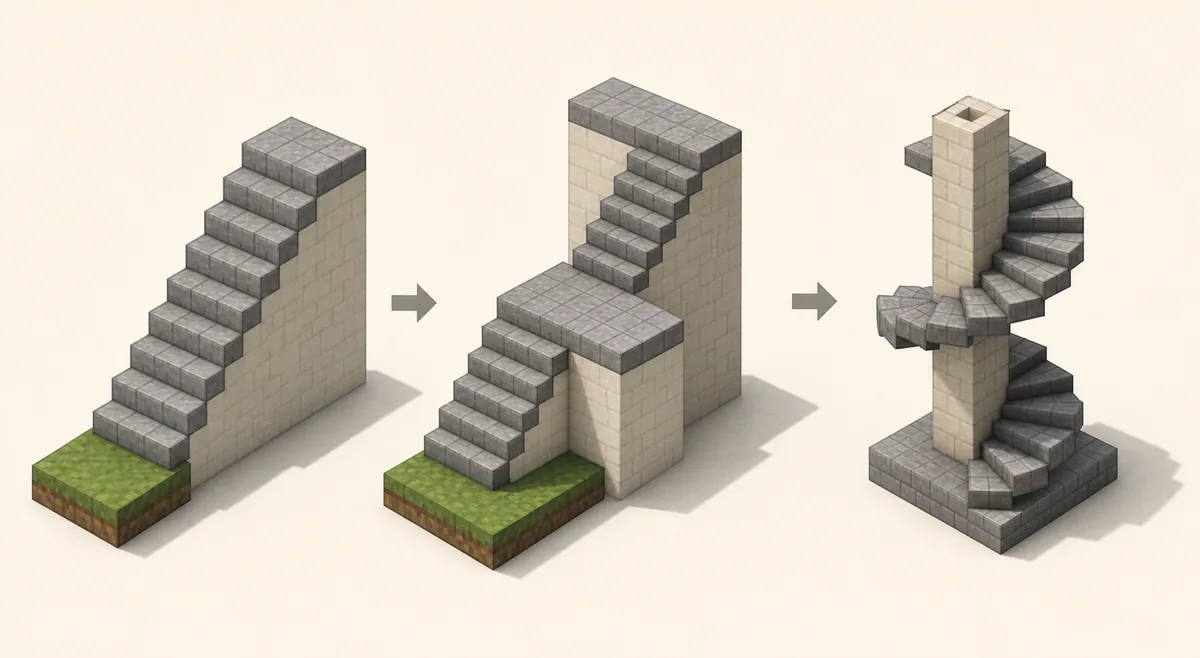
Step
The main climb surface. It should stay readable and safe from normal player eye level.
Landing
The pause or turn point that connects floors, towers, cliffs or rooms.
Edge
The rail, wall, trim or support line that explains the staircase boundary.
Survival-Friendly Minecraft Staircases
In survival mode, start with blocks you can craft in volume: oak, spruce, cobblestone, stone bricks, andesite, tuff, sandstone and deepslate. Rare blocks such as quartz, sea lanterns, amethyst, copper or blackstone variants work better as accents than as the entire staircase.
Build a one-section sample before committing to a long stairwell. Test the step material, side wall and lighting rhythm over five to seven blocks. If it looks noisy in a small sample, it will look worse across a tower or ravine.
Use lighting as part of the design. Lanterns on posts, torches tucked into side walls, sea lanterns under slabs or shroomlights in nether stairs can make the route readable without adding random decoration.
Common Minecraft Stairs Design Mistakes
Decorating before choosing the path
If the route, width and landing are unclear, railings and lamps cannot rescue the design.
Using too many stair materials
Different stair blocks change texture and direction quickly. Keep one main step block and use variety on borders or landings.
Forgetting the side view
Players often see stairs from below or beside them. Add support, walls or trim where a staircase would otherwise look like floating steps.
Making spiral stairs too tight
A spiral needs enough space, a center column and repeated edge cues. Otherwise it becomes hard to climb and visually messy.
Stopping at the top with no transition
Connect the stair into the next floor, balcony, path or doorway with shared materials and a clear arrival point.
FAQ
What is the best Minecraft stairs design for beginners?
A straight three-block-wide wooden or stone staircase with a simple border, one landing and repeated lights is the easiest beginner design. Keep the route clear before adding detail.
How wide should Minecraft stairs be?
Utility stairs can be one block wide. House entrances and base stairs usually look better at three blocks wide. Grand halls, castles and terraces can use five blocks or more if the border and landing rhythm stay clear.
What blocks are good for stone stairs in Minecraft?
Stone brick stairs, andesite, tuff, cracked stone bricks, cobblestone, deepslate tiles and mossy cobblestone are strong stone stair choices. Use darker blocks on side trim, bases and lower levels.
How do I make a spiral staircase look good in Minecraft?
Use a center column, repeat the same stair block, add a consistent edge treatment and place small landings at floor entrances. Avoid mixing too many colors inside the spiral.
Is this page about crafting stairs?
No. Crafting questions are covered briefly, but this guide focuses on Minecraft stairs design: layout, palette, landings, railings and how stairs connect to the rest of a build.
Turn a Stair Palette Into a Buildable Gradient
Choose the layout first, then compare nearby blocks in the generator before rebuilding a full staircase, tower climb or garden terrace.
Use the Minecraft Gradient Generator