Quick Answer: Best Spruce Wood Gradient in Minecraft
The most reliable spruce wood gradient in Minecraft is stripped spruce log -> spruce planks -> spruce stairs or slabs -> spruce trapdoors -> dark oak accents. Use the lighter stripped texture on broad faces or highlights, let regular spruce planks carry most of the wall, then reserve darker blocks for eaves, beam undersides, window frames, fences and shaded corners.
A good spruce gradient should explain the structure. Logs can read as posts, planks as wall infill, stairs and slabs as trim, and trapdoors or dark oak as shadows. When every block is mixed evenly, the build stops looking like crafted wood and starts looking noisy.
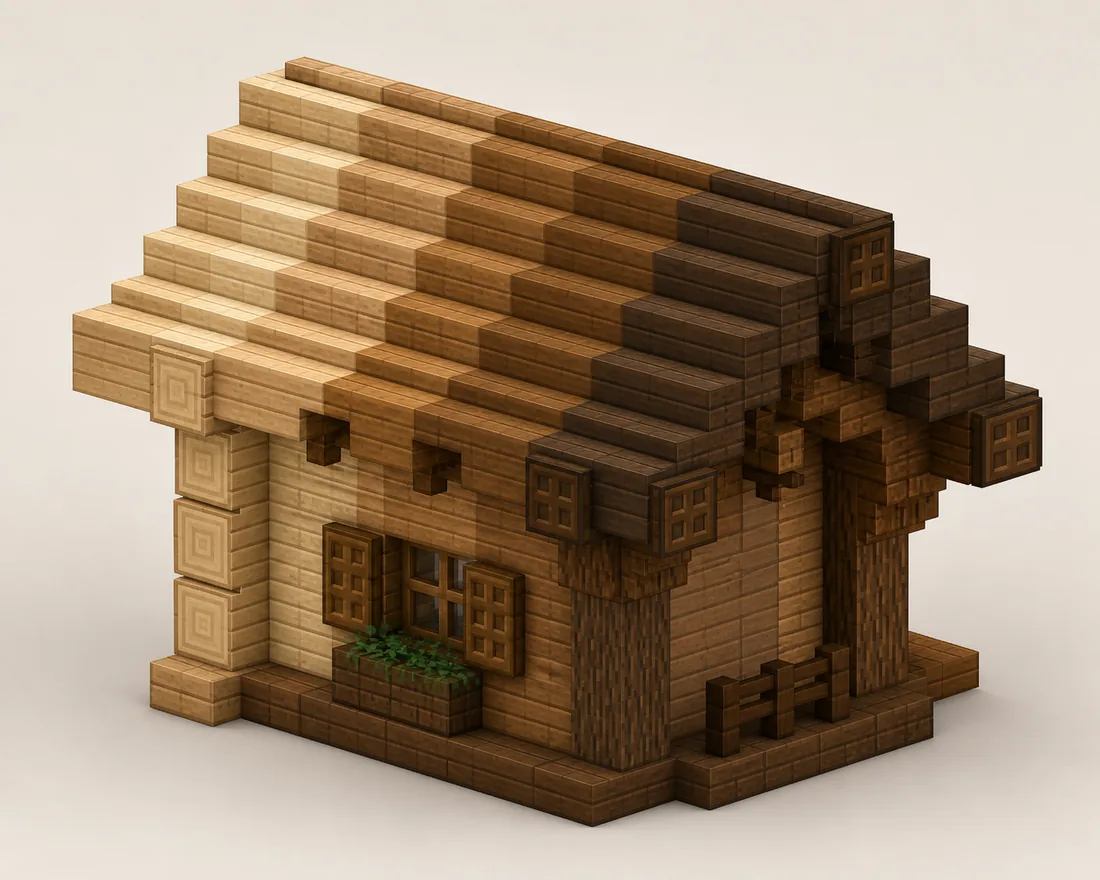
Fast placement rules
- Keep 50 to 60 percent of the surface as the main spruce plank tone.
- Use stripped spruce logs for posts, bright highlights and cut-log details.
- Place darker spruce or dark oak under overhangs, window frames and beam shadows.
- Use stairs, slabs, fences and trapdoors to add depth before adding more colors.
- Test a 7-by-7 sample wall before repeating the palette across a full cabin.
- Avoid mixing every wood family unless the build is intentionally rustic.
Why Spruce Wood Gradients Work
Spruce is popular because it sits between warm oak and very dark roof materials. That makes it flexible for cabins, medieval houses, starter bases, barns, bridges and watchtowers. The risk is that a large flat spruce wall can become one brown sheet, especially when the same plank block covers every face.
A controlled wood gradient solves that by separating value, texture and function. Light stripped logs catch attention on posts and corners. Medium planks stay calm across the main wall. Dark trapdoors, fences or dark oak blocks create shadow where the build already has depth. The palette feels intentional because each step supports the architecture.
For exact vanilla wood block names and variants, compare your palette with the Minecraft Wiki wood reference before planning survival material lists or command names.
Competitor pages often show a single inspiration image or a copied palette list. The missing piece is placement: where each tone belongs, what percentage to use, and how the gradient changes between a wall, roof, beam or floor. This guide focuses on those decisions so the palette can be rebuilt in survival instead of only admired as a screenshot.
If you want to compare candidate blocks first, open the Minecraft Gradient Generator then return to this page to decide where the spruce tones should sit in the build.
7 Spruce Wood Gradient Palettes
Use these palettes as starting recipes. Adjust them for biome color, resource pack, build size and whether the surface is a wall, roof, beam frame or floor.
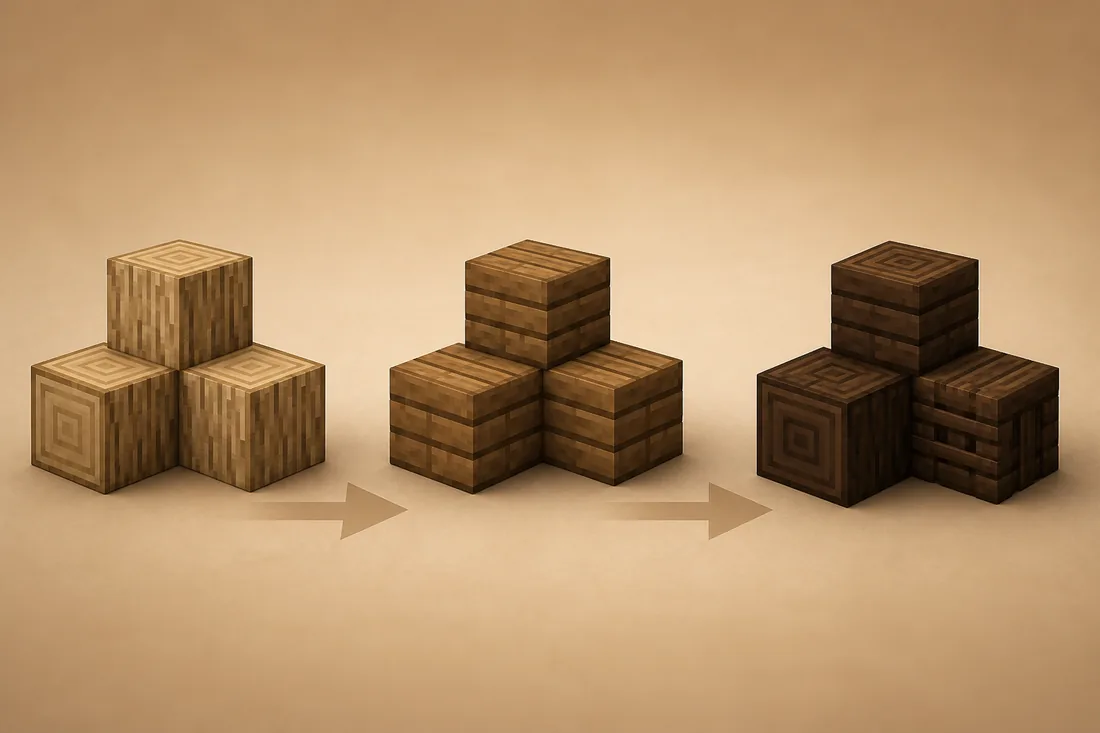
| Use case | Gradient sequence | Best placement |
|---|---|---|
| Cabin wall | stripped spruce log -> spruce planks -> spruce stairs -> spruce trapdoor -> dark oak trapdoor | Logs on corners and posts, planks on the middle wall, darker trim under windows and roof edges. |
| Medieval beam frame | stripped spruce log -> spruce log -> spruce planks -> dark oak planks -> dark oak fence | Bright logs for exposed cuts, dark oak only on inner frames and deep shadows. |
| Spruce roof | spruce planks -> spruce stairs -> spruce slabs -> spruce trapdoors -> dark oak stairs | Keep the slope mostly spruce and darken eaves, ridges, chimneys and underside shadows. |
| Village barn | stripped spruce wood -> spruce planks -> coarse dirt -> mud bricks -> dark oak | Use earthy dark blocks only near the foundation or stall openings. |
| Forest bridge | stripped spruce log -> spruce slab -> spruce trapdoor -> campfire top -> dark oak fence | Lighten walking planks and darken rails, supports and waterline shadows. |
| Cozy interior wall | stripped spruce log -> spruce planks -> barrel -> lectern -> dark oak trapdoor | Use work blocks as accents, not random patches across the whole room. |
| Ruined cabin | spruce planks -> stripped spruce log -> spruce trapdoor -> mud brick -> dark oak plank | Cluster darker blocks near broken corners, floor rot and damp foundations. |
Where to Use a Spruce Gradient
Use spruce gradients on surfaces that already belong to a wooden structure: cabin walls, beams, roofs, fences, barns, bridges, dock supports and interior panels. The palette works poorly when it is pasted onto unrelated stone, copper or nether builds without a material bridge.
For a cabin wall, put the cleanest planks where the wall needs to read flat and usable. Put darker blocks where shadow would collect: under roof lips, behind beams, near floor level and inside window recesses. For a roof, shift the strongest contrast toward eaves and dormers because players usually view roofs from below or at an angle.
How to Place Spruce Blocks Without Random Noise
Start with shape before texture. Build the cabin silhouette, roof slope, post spacing, window positions and door frame using one main spruce block. Once the build reads clearly, replace a controlled share of blocks with lighter or darker variants.
A reliable split is 55/25/15/5. About 55 percent should be the main spruce planks, 25 percent a close variant such as stairs, slabs or stripped logs, 15 percent darker trim, and 5 percent the strongest accent. If the accent reaches every row, it stops being a shadow and becomes visual static.
Keep direction consistent. Vertical posts can be light on the outside and darker under beams. Roofs can darken at the eaves. Floors can become darker near fireplaces, doors and storage corners. The gradient should follow how the wood is used, not a checkerboard pattern.
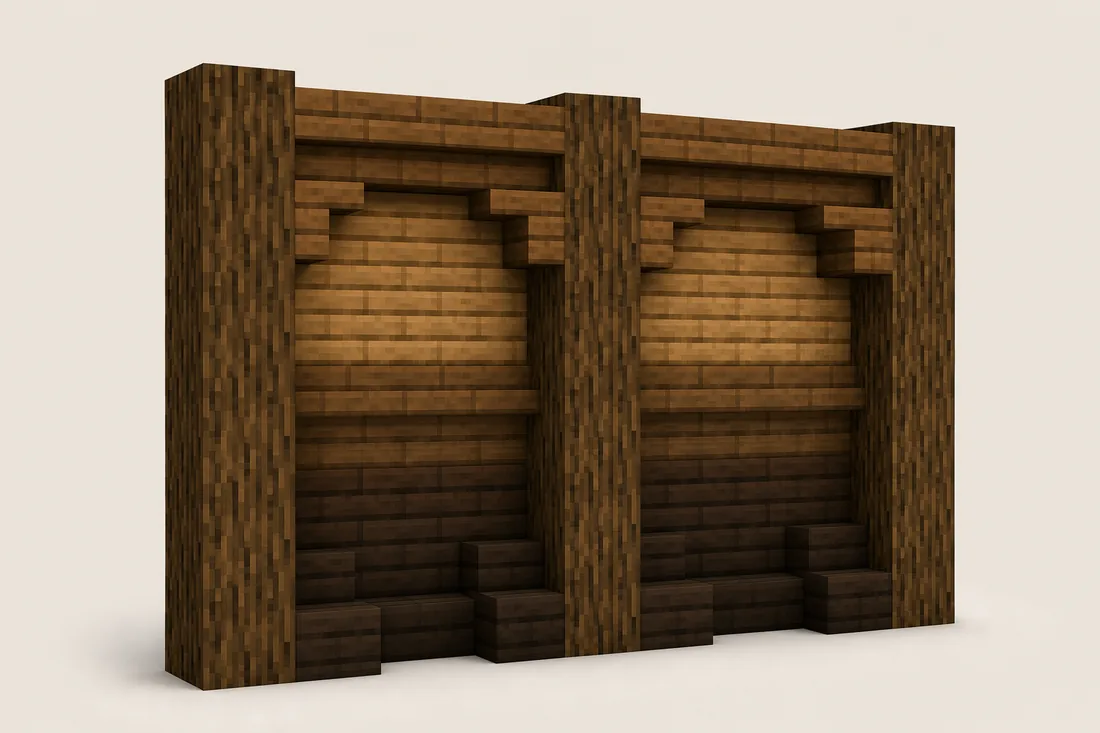
For cabins
Use stripped logs on corners, spruce planks across the wall, and trapdoors below windows or roof edges.
For roofs
Keep the main slope calm and darken eaves, ridge caps, dormers and chimney contact points.
For interiors
Use barrels, lecterns, bookshelves or trapdoors as functional accents instead of random dark patches.
Survival-Friendly Spruce Gradient Swaps
In survival mode, spruce logs and planks are cheap once you find a taiga, old growth taiga or snowy forest. Start with stripped spruce logs, spruce planks, slabs, stairs, fences and trapdoors before importing darker wood families. That single-family palette is easier to gather and still gives enough value range for most starter bases.
If you do not have dark oak yet, use spruce trapdoors, unstripped spruce logs, barrels, campfires with extinguished tops, or shadow from stairs and slabs as the dark step. If you do have dark oak, use it sparingly on the deepest trim so the build remains a spruce build rather than turning into a mixed-wood wall.
For large villages, repeat the same placement logic across several houses but vary one accent per building. One cabin might use trapdoor shutters; another might use barrel storage; another might use fence supports. That keeps the settlement cohesive without making every house identical.
Common Spruce Wood Gradient Mistakes
Mixing every brown block
Spruce, dark oak, mud bricks, barrels, stripped logs and campfires can work together, but not all at equal volume. Choose a main wood story first.
Ignoring block function
A log that should be a post feels wrong when it appears randomly in the middle of a plank wall. Put blocks where their texture makes structural sense.
Making the roof too busy
Roofs already have stairs, slabs and shadows. Too many colors on the slope can distract from the silhouette.
Forgetting distance
A subtle spruce gradient may disappear from far away. Test the wall from the path, gate or courtyard where players will actually see it.
Spruce Wood Gradient FAQ
What is the best spruce wood gradient in Minecraft?
A strong starter palette is stripped spruce log, spruce planks, spruce stairs or slabs, spruce trapdoors and dark oak accents. Use the lighter blocks on posts and highlights, planks on the main wall, and darker blocks under eaves or around windows.
Can I make a spruce gradient without dark oak?
Yes. Use spruce trapdoors, spruce logs, barrels, campfire tops, stairs and slab shadows as the darker steps. Dark oak is helpful, but it is not required.
Is a spruce roof gradient different from a spruce wall gradient?
Yes. A wall gradient follows posts, windows, floor shadows and beam frames. A roof gradient follows slope, eaves, ridge caps, dormers and the viewing angle from below.
How many wood blocks should a spruce build use?
Small cabins usually need three to five variants. Larger houses, barns and bridges can use six or seven if the main material still covers most of the surface.
Should I mix oak and spruce in one gradient?
You can, but use oak only when the build needs a lighter step. Too much oak can make the palette feel like two wood types pasted together rather than one spruce gradient.
Build the palette before placing hundreds of blocks
Use the generator to compare adjacent wood, stone and terrain blocks, then apply the spruce placement rules from this guide to your cabin or village build.
Open the Minecraft Gradient Generator