Quick Answer: How to Make a Minecraft Garden Look Designed
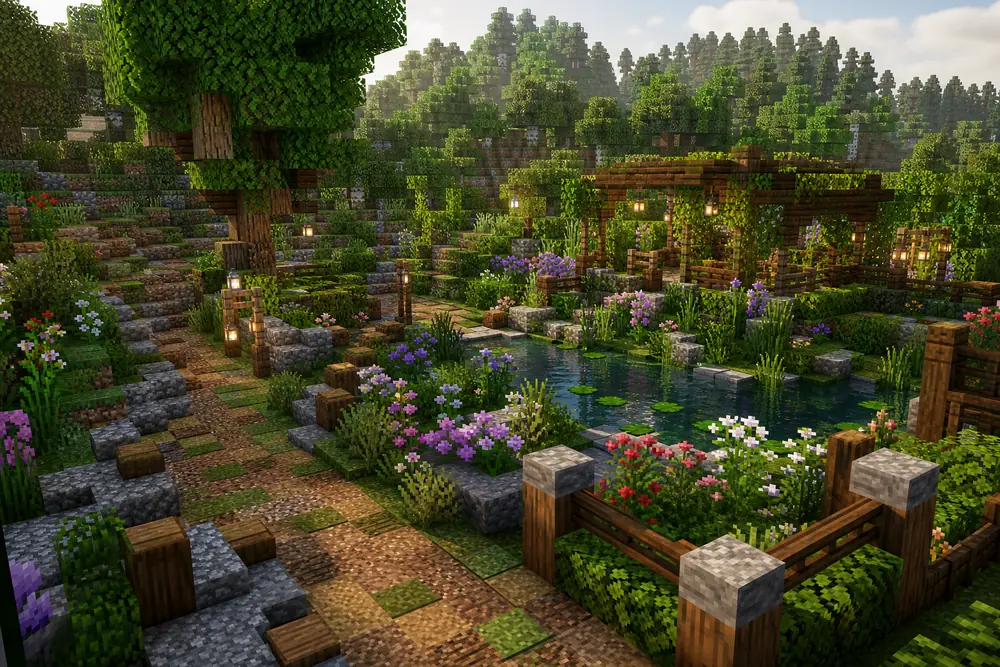
The most reliable Minecraft garden starts with a route, a planting zone and one clear focal point. Put the main path down first, then place flower beds, crops, a pond, a seating nook or a small greenhouse around that route. This gives the garden a purpose instead of turning it into a flat patch of random flowers.
Use a simple visual ratio for most builds: about 50 percent walkable ground, 30 percent planting or terrain, and 20 percent accents such as water, fences, lanterns, benches or a pergola. The exact numbers can change, but every block should support movement, framing, color or story.
For a starter garden, combine grass or moss, coarse dirt, a small number of flowers, spruce or oak trim and a few stone blocks. For a larger estate, repeat the same roles in separate rooms: a formal courtyard, a crop area, a tree corner and a water edge.
Fast Minecraft Garden Recipe
- Choose the garden job first: decoration, crops, relaxation, entrance framing or a mix.
- Draw the walking route before filling the space with plants.
- Use one main ground block, one border family and one accent family.
- Group flowers and leaves into beds instead of scattering every color evenly.
- Place water, seating and lanterns at turns or focal points where they help orientation.
- Test the garden from normal player height before repeating it across a large area.
Minecraft Garden Design Rules That Keep Builds Readable
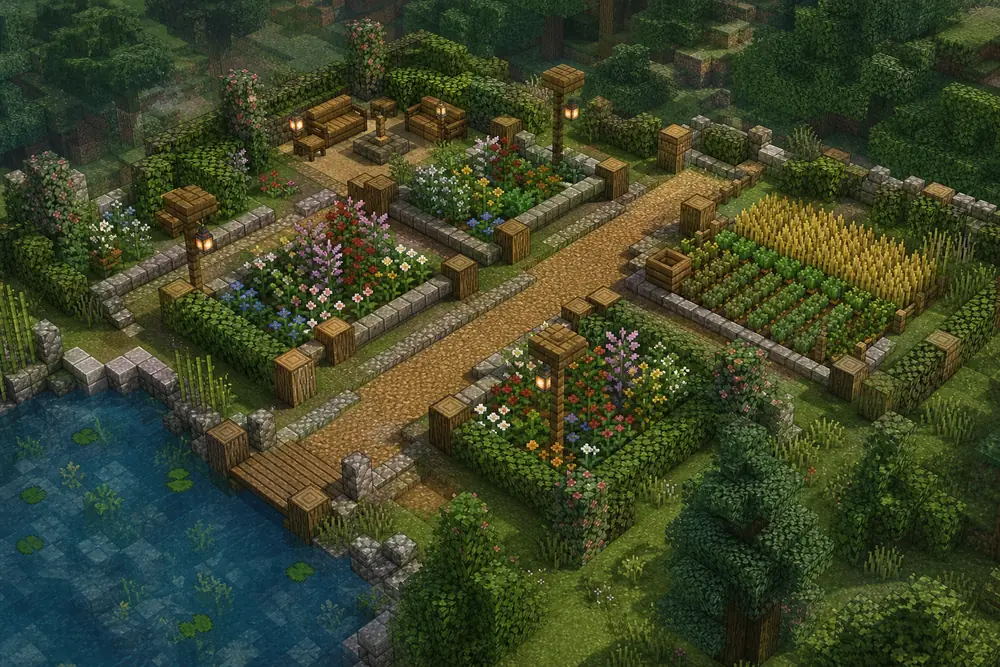
A garden is easier to build when it is treated as a sequence of outdoor rooms. A path is the circulation layer, hedges and low walls are the boundaries, plants provide texture, and a pond, tree, pergola or fountain becomes the visual anchor. This structure works for a tiny starter yard as well as a large castle courtyard.
Block choice should follow the garden's mood. Moss, rooted dirt, coarse dirt and stone create a natural transition. Spruce, oak, trapdoors and fences make the space feel built. Bricks, polished stone, calcite or copper can signal a formal or fantasy garden, but stronger blocks should stay in borders and focal points rather than cover every surface.
Before finalizing a flower list, check the Minecraft Wiki flower reference for block names and planting details.
Scale matters more than decoration. A two-block-wide path can feel generous in a small yard but too narrow beside a mansion. Keep the path, bed and border widths proportional, and leave enough empty ground for the player to read the shape from a distance.
A garden can also extend the palette of the building beside it. Match the house, barn or castle with one shared wood, stone or accent family, then let leaves and flowers soften the transition. Use the generator when two possible border blocks look close in the inventory but behave differently next to grass, moss or water.
For the route itself, compare the Minecraft path gradient guide before choosing the final ground sequence.
12 Minecraft Garden Ideas and Layouts
Use these Minecraft garden ideas as buildable starting points. Swap blocks for your biome, available materials, garden size and the building that the garden needs to support.
| Garden style | Block palette | Best placement |
|---|---|---|
| Small starter garden | grass -> coarse dirt -> oak slabs -> poppies | Frame a short path with one flower bed and a single oak bench or composter. |
| Cottage front garden | moss -> rooted dirt -> spruce trapdoors -> lanterns | Keep planting close to the entrance and use a low hedge to frame the door. |
| Formal courtyard | stone bricks -> polished andesite -> leaves -> water | Use symmetry, four beds and a center fountain or tree to organize a square courtyard. |
| Vegetable garden | farmland -> coarse dirt -> oak fences -> composter | Align crop rows with a two-block service path and leave room for water channels. |
| Pond garden | moss -> cobblestone -> clay -> spruce | Let the pond edge be irregular, then use a bridge, reeds and a seating point to create a destination. |
| Greenhouse garden | stone bricks -> glass -> oak -> moss | Place the greenhouse at the back of the garden so the path and planting beds remain visible from the entrance. |
| Forest garden | podzol -> coarse dirt -> spruce -> moss carpet | Use uneven tree spacing, low lights and rough paths instead of a rigid grid. |
| Medieval monastery garden | stone bricks -> gravel -> spruce -> white flowers | Build four simple beds around a central well, cross or small tree. |
| Hanging terrace garden | stone -> dark oak -> leaves -> vines | Stack narrow beds along a cliff or roof terrace and connect them with stairs or slabs. |
| Cherry or fantasy garden | pink petals -> calcite -> cherry wood -> lanterns | Keep the bright color in focal beds and use neutral stone to stop the palette becoming noisy. |
| Farmyard garden | dirt path -> hay bale -> oak fence -> wheat | Connect crops, animal pens and a barn with one shared path and repeated fence posts. |
| Secret garden | mossy stone bricks -> vines -> dark oak -> glow berries | Hide the entrance behind leaves, then reveal one small interior clearing with a strong light source. |
How to Place Paths, Water, Plants and Lighting
Start with the route that players will actually use. Connect the house door, farm, barn, storage, bridge or gate before adding decoration. A garden path should widen at a destination and narrow only where the build intentionally feels enclosed.
Use planting beds to control rhythm. Rectangular beds look formal and are easy to repeat; irregular beds feel natural but need a clear edge so they do not melt into the path. Group flowers by height or color, and leave small calm areas where leaves, moss or grass can carry the transition.
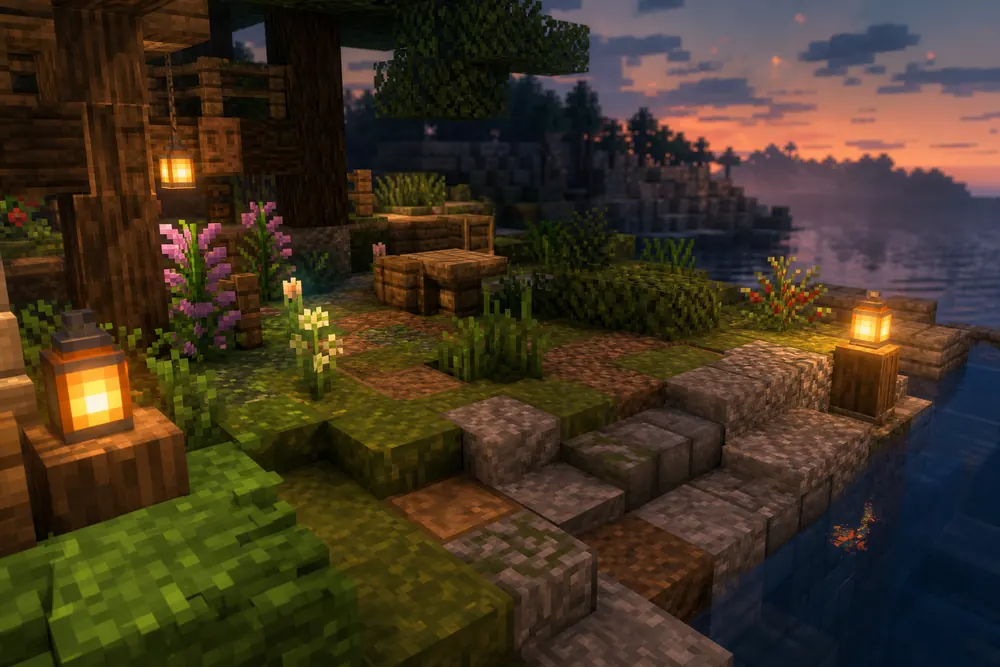
Treat water as a destination instead of a filler block. A small pond becomes more useful when it has a bridge, reeds, a tree, a bench or a change in elevation nearby. Lighting should follow the route and focal points, not form a bright grid across every bed.
Route
The walkable line through the garden. Keep it wide enough for the build scale and connect it to real entrances.
Bed
The planting or crop zone. Give it a border, a repeatable shape and enough empty space to read from a distance.
Anchor
The object that makes a destination: a pond, tree, pergola, fountain, greenhouse, bridge or seating nook.
Light
Lanterns, glow berries and hidden lighting that guide movement while keeping the garden mood intact.
Survival-Friendly Minecraft Garden Builds
In survival mode, start with materials that can be gathered in volume: dirt, grass, coarse dirt, gravel, stone, cobblestone, oak, spruce, fences, slabs and common flowers. A garden made from repeatable blocks is easier to finish and usually looks more coherent than a design that depends on rare accents everywhere.
Use expensive or slow-to-farm blocks as punctuation. Copper, prismarine, sea lanterns, polished blackstone, glazed terracotta and rare flowers can mark a fountain, gate, greenhouse or focal bed without turning the whole garden into a resource project.
Plan lighting before the final planting pass. Lanterns on fence posts, hidden light under leaves and a few brighter focal points can protect the route while preserving contrast. Test the garden at night so the path remains readable and the flowers do not disappear into one dark mass.
Common Minecraft Garden Design Mistakes
Scattering every flower evenly
Even distribution removes hierarchy. Give each bed a limited palette and let a few flowers become accents.
Building decoration before the route
If paths are added last, they cut through beds and fences. Decide the circulation first and decorate around it.
Making the garden too flat
One or two height changes, a raised bed, a small bridge or a sunken pond can create depth without a huge terraforming job.
Using a bright block everywhere
Quartz, copper, sea lanterns, glazed terracotta and vivid flowers attract attention. Keep them near entrances, centers and landmarks.
Ignoring the building beside it
A garden should connect to the house, barn, castle or path palette. Repeat one wood or stone family so the outdoor space feels attached.
FAQ
What is the best Minecraft garden idea for beginners?
Start with a short path, one flower bed, a small tree and a fence or hedge. Grass, coarse dirt, oak, spruce, stone and common flowers are easy to gather and give the garden a clear structure.
How big should a Minecraft garden be?
A small seven-by-seven or seven-by-nine garden is enough for an entrance or starter house. Larger gardens can use separate rooms for crops, flowers, water and seating, but each room should keep a readable route.
How do I make a Minecraft garden look less random?
Give blocks roles: ground, border, planting, anchor and light. Repeat those roles in small modules, group flowers instead of scattering them, and keep the main path visible from the entrance.
What blocks look good in a Minecraft garden?
Grass, moss, rooted dirt, coarse dirt, gravel, stone, cobblestone, oak, spruce, leaves, fences, slabs and lanterns are reliable starting points. Add copper, prismarine or rare flowers only as focal accents.
Should a Minecraft garden have a pond?
A pond is useful when it creates a destination or changes the garden's height and rhythm. Add a bridge, reeds, a tree, a bench or a path bend so the water feels intentional rather than like an empty hole.
Turn a Garden Palette Into a Buildable Block Sequence
Compare nearby grass, dirt, moss, stone and wood blocks in the generator before you repeat a path, border or garden room across the whole build.
Use the Minecraft Gradient Generator